DaGarupa
Experimentation is an essential part of creativity. By exploring the relationships between architecture, cities, and people, graphic interventions emerge from the desire to connect these agents through visual narratives.
www.dagarupa.com.br
Authors: Crislayne O. Marques, Guto Miranda, and Marina Dahmer.
Supervised by: Celso Longo, Daniel Trench, and Francesco Perrotta-Bosch.
In 2021, the postgraduate course "Graphic Design and the City" opened its first class at Escola da Cidade, as an environment for building and sharing ideas, where urban spaces are the main theme and support for intervention.
Even during a delicate moment of the COVID-19 pandemic, when we were submerged in consecutive waves of fear and uncertainty, we focused on an urgent topic that remains relevant: the precarious working conditions of app-based delivery workers.
As the pandemic worsened, the layers of the relationship between technology companies and workers deteriorated, exposing the consequences of a precarious work model strongly linked to the monopolization of the delivery market by apps.
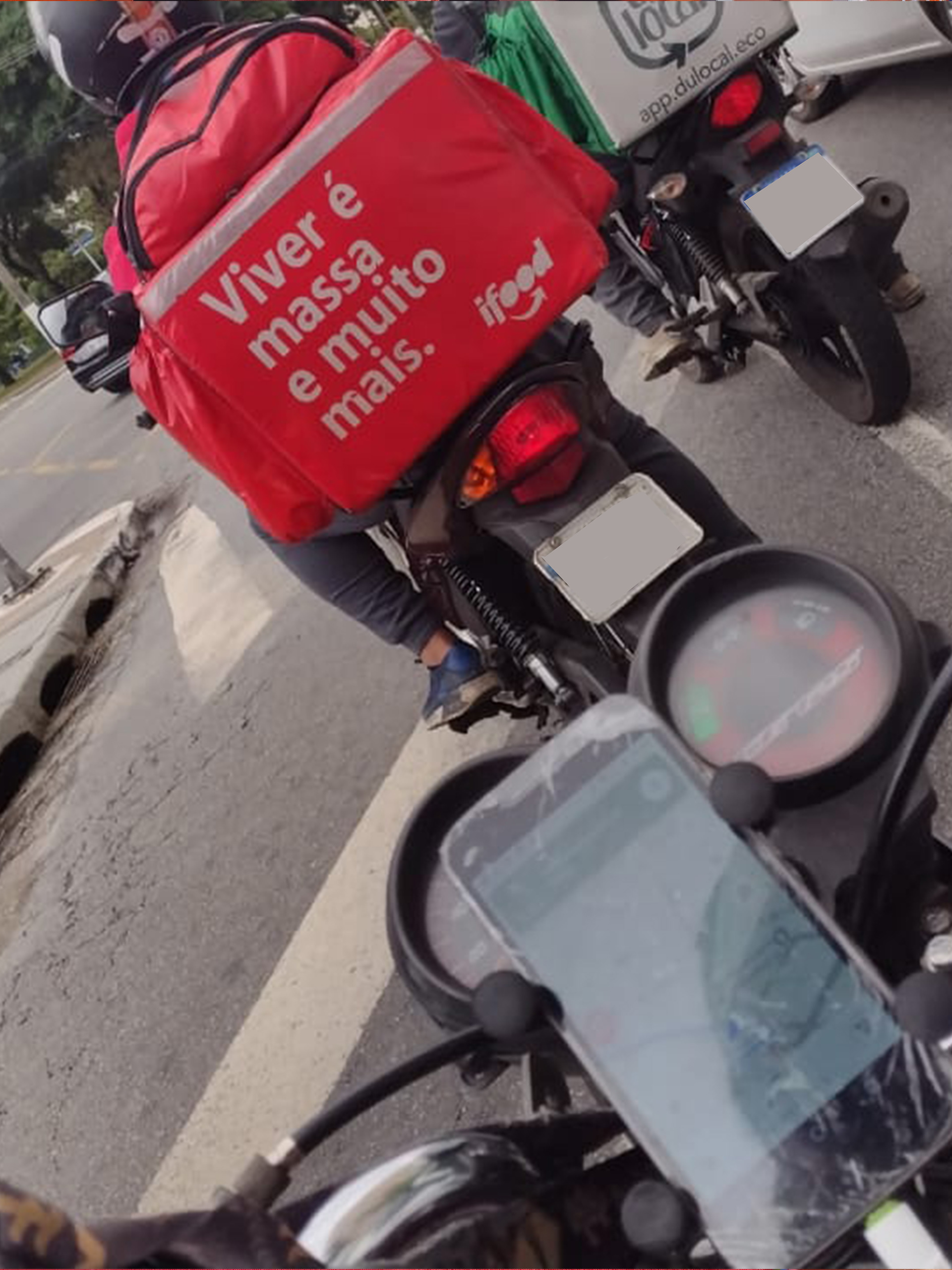
Given the context of mobilization and protest by the category, we sought to understand the reality of these professionals who took to the streets of São Paulo, carrying the demands of the isolated population up and down the streets, a population that knows little (or wants to know little) about those who make the system work. This gave rise to "DaGarupa", a project that seeks to bring app users and delivery professionals closer together, presenting the journeys of four workers who shared their stories through accounts and visual records.
The project began with general research—in articles, reports, documentaries, and academic works—followed by exchanges with delivery workers through interviews and recordings of their work routines. For this last stage, which required more time and effort, we paid the people who shared their journeys, and the result was a series of multimedia diaries—photos, audios, videos, and text messages—recorded by the workers themselves throughout the day.
The chosen medium for displaying these diaries was the screen, where the entire relationship between delivery workers, restaurants, and customers takes place, always mediated by the apps. Screens were also the primary means of contact and information exchange among everyone involved in the project: from interviews to daily logs, all material was produced and shared using the phones that notified delivery requests.
This process gave rise to www.dagarupa.com.br, which presents the stories of Priscila, Paulo, Johnata, and Pedro from their own points of view.